
When Liquidity and Markets Begin to Move Together
March 30th 2026
Markets are already adjusting — while liquidity conditions are beginning to shift alongside them
There’s Something Worth Noting
There are moments where individual data points matter less than how they begin to interact.
Over the past several weeks, markets have already been adjusting.
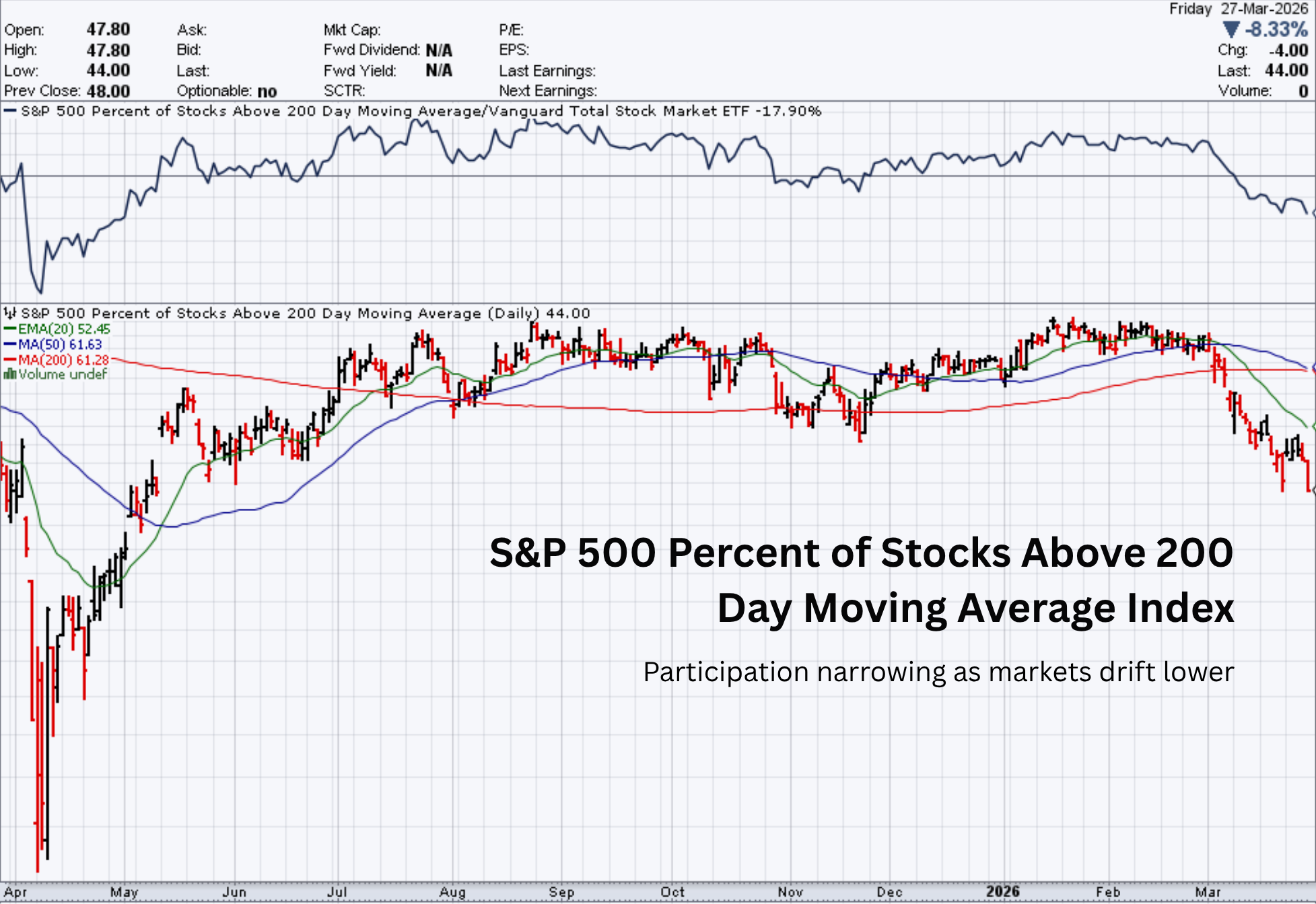
Equities have continued to drift lower, participation has narrowed, and credit spreads have begun to widen. None of these moves are extreme—but the direction has been consistent.
At the same time, another development has quietly re-emerged.
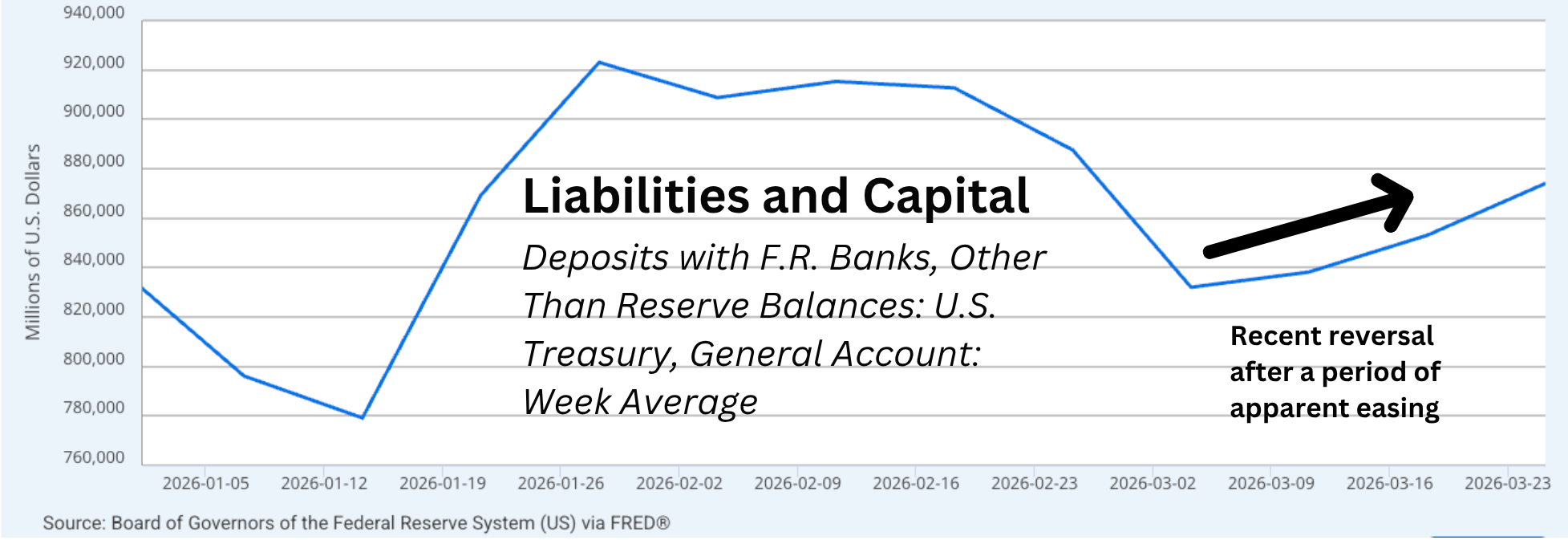
After appearing to stabilize—and even ease—the U.S. Treasury’s cash balance has now begun to rise again.
On its own, that might not stand out. But in the context of already-softening markets, it becomes more interesting.
And it leads us to a simple question:
If markets are already under some pressure, what happens if there’s simply less liquidity available to go around?
What We’re Actually Seeing
Let’s anchor this in the data.
The Treasury General Account (TGA)—effectively the government’s cash balance at the Federal Reserve—has now increased for three consecutive weeks, rising back toward recent highs.
Current level: ~$874B
Recent peak (8 weeks ago): ~$974B
A few weeks ago, the trajectory suggested liquidity might be easing back into the system. That direction has, at least for now, reversed.
At the same time:
Equities (S&P 500, Nasdaq) continue to trend lower
Market breadth continues to deteriorate
Credit spreads (High Yield vs Investment Grade) are widening
Emerging markets and China credit have rolled over
Individually, none of these are definitive.
Together, they suggest that markets are already adjusting to tighter conditions.
What the TGA Actually Does
To understand why this matters, we need to understand what the TGA represents.
The Treasury General Account is the pool of cash the U.S. government holds at the Federal Reserve.
When that balance rises, cash is effectively pulled out of the private financial system.
When it falls, that cash is released back into the system.
This is not a directional policy signal—it’s operational.
But mechanically, it influences how much liquidity is available across markets.
It’s less about intention, and more about where cash is sitting at a given moment in time.
Why This Moment Stands Out
What makes this moment notable is not the TGA in isolation—and not market weakness in isolation.
It’s the overlap.
Markets have already begun adjusting—gradually, but consistently.
At the same time, liquidity—at least at the margin—is no longer clearly easing.
These developments are occurring at the same time—and that overlap is worth paying attention to.
We are not seeing stress.
But we are beginning to see alignment across different layers of the system.
Exploring the Question
So we return to the question:
If markets are already under some pressure, what happens if there’s simply less liquidity available to go around?
Rather than jumping to conclusions, it’s more useful to think through how this dynamic works.
Markets Are Sensitive to Liquidity—Especially at the Margin
Markets are not driven by fundamentals alone—they are heavily influenced by the availability of capital.
When liquidity is abundant:
Risk is more easily absorbed
Volatility tends to compress
Credit flows more freely
When liquidity becomes more limited:
Markets become more sensitive
Positioning becomes more cautious
Buyers become more selective
This doesn’t create immediate stress—but it changes behavior.
Liquidity Doesn’t Need to Collapse to Matter
Even small shifts can:
Reduce excess cushion
Increase sensitivity to new information
Amplify existing trends
This becomes more relevant when markets are already in a fragile or adjusting state.
This Is About Interaction—Not Direction
It’s tempting to simplify:
“Liquidity down → markets down”
But that misses the point.
What matters is that markets and liquidity are now interacting, rather than moving independently.
That interaction is where insight lives.
The System Remains Stable
Despite all of this:
Funding markets are functioning
No signs of systemic stress
No breakdown in financial plumbing
The system itself remains stable.
And that’s an important anchor.
What This Means for Investors
Understanding this dynamic changes how we interpret the environment.
It’s no longer just about direction—it’s about conditions.
Right now:
Markets are adjusting
Liquidity is no longer clearly easing
Credit is beginning to reflect caution
But the system remains stable
That combination matters more than any single signal.
Closing Thought
Markets are already moving.
At the same time, liquidity conditions are beginning to shift at the margin.
Neither development alone defines the moment—but together, they begin to shape it.
For now, that interaction is simply something worth paying attention to.
Look out for next week’s newsletter for further insight into the forces shaping today’s markets.