
Strategy's Q1 Credit Scale-Up
May 11th 2026
Bottom Line
Strategy's Q1 2026 cycle was less about the earnings print than about market access: $11.7B raised year to date, STRC scaled to $8.5B in nine months, and management now claims 60% of the US preferred new-issue market. The clearest evidence is the preferred side itself, with $5.6B raised YTD entirely through STRC and cumulative preferred notional at $12.13B. For readers tracking Bitcoin-linked capital formation, the point is simple: Strategy is now large enough to matter inside the preferred market, not just around its own balance sheet. Full comprehensive research report can be found below:
Thesis
This week is a single-name dispatch, and the question is straightforward: what did Strategy's Q1 2026 cycle actually advance? The answer is scale in capital markets, not a new change in corporate identity. Q1 showed that STRC is scaling fast enough to register as market structure, not just company financing.
What Changed
Last week the newsletter was about US GDP composition. This week the frame shifts to a single issuer whose funding program is now large enough to matter beyond the Bitcoin treasury story.
The change is scale. STRC reached $8.5B of notional in nine months, cumulative preferred equity reached $12.13B, and management says Strategy now represents 60% of the US preferred new-issue market in 2026 year to date. This week's update is that the structure kept compounding through Q1.
Evidence
The headline quarter was large, but the funding side mattered most
Strategy ended the cycle with 818,334 BTC as of May 3, equal to 3.9% of total Bitcoin supply. At the same time, the software business still generated $124.3M of Q1 revenue, up 11.9% year over year, with subscription services up 59%.
The cleaner message from the quarter was capital access, not KPI acceleration. The BTC stack kept growing, but the operating figures were more mixed than the balance-sheet scale alone suggests.
Q1 BTC Yield was 3.2%, versus 11.0% in Q1 2025.
YTD 2026 BTC Yield was 9.4%, versus 22.8% for FY2025.
BTC Gain in Q1 was 21,329 BTC, versus 49,132 a year earlier.
BTC $ Gain in Q1 was $1.45B, versus $4.05B in Q1 2025.
That mix matters for the weekly thesis because it keeps the focus on financing capacity. The quarter did add Bitcoin, but the more important development was the company's ability to keep converting investor demand into fresh balance-sheet firepower.
The quarter was really a STRC scaling story
Year to date, Strategy raised $11.7B of capital: $6.1B of common and $5.6B of preferred. On the preferred side, the issuance was effectively all STRC.
Q1 ATM net proceeds totaled $7.36B.
Of that, $5.29B came from Class A and $2.06B from STRC.
STRK contributed just $3.0M, while STRF and STRD ATMs were dormant.
Cumulatively, STRC has reached $8.5B in nine months, which management describes as the largest preferred stock by market cap in the world. Across the preferred stack, total notional is $12.13B, with STRC accounting for more than 60% of the total.
Management is still tuning the product as it scales. STRC's dividend rate was raised from 11.25% to 11.50% effective March 1, 2026, and shareholders are being asked to approve a shift from monthly to semi-monthly dividends starting in July 2026 if approved. The quarter also showed issuance flexibility: January was 88% credit and 12% common, while April flipped to 17% credit and 83% common as the Bitcoin drawdown reweighted the mix.
That issuance mix is useful because it shows management is not treating the stack as static. The common and preferred channels are being adjusted in real time, but the preferred growth engine inside that stack is clearly STRC.
The market-share figures are now too large to ignore
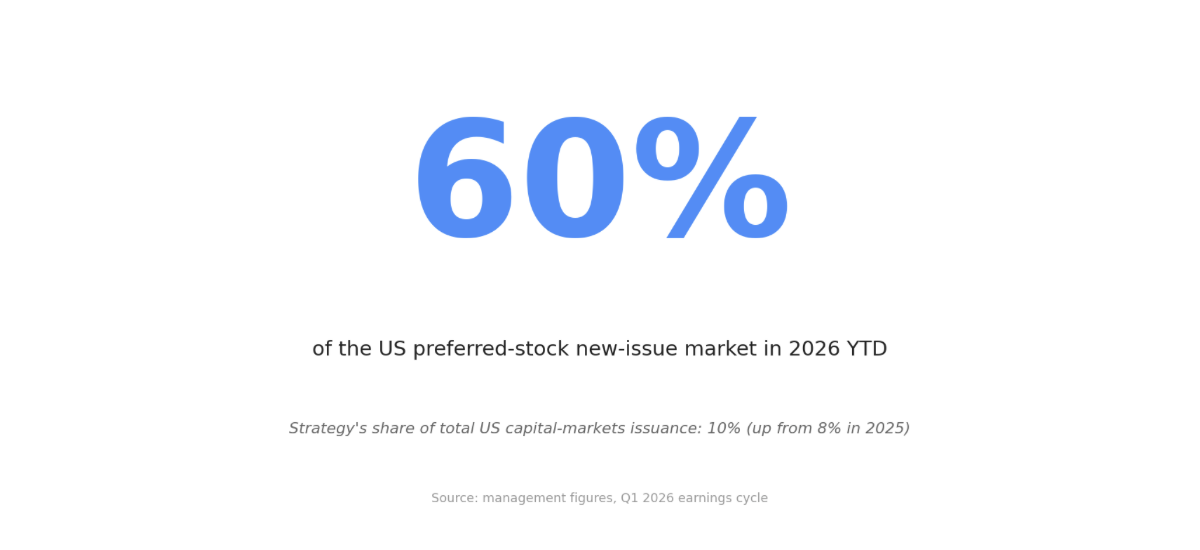
Management says Strategy's share of US capital-markets issuance rose from 8% in 2025 to 10% in 2026 year to date. Inside that, it claims 60% of the preferred-equity new-issue market and 6% of the common-equity market.
The microstructure signals line up with that claim. STRC daily liquidity rose from $54-120M in January to $360M in April, management says turnover is 10 times Wells Fargo preferred, and STRC is now the #2 holding in BlackRock's PFF, a $14B preferred ETF.
There is still a limit worth keeping explicit. Even the supplied work's closest candidate for a Treasury-like instrument, STRF, had a peak-to-trough drawdown of -21.76% over 37 weeks and traded at a +533 basis point spread versus the US 10-year in the November 15 reference snapshot. The stack is scaling, but it is still pricing as risk capital, not as a cash substitute.
Implications
Q1 makes the monitoring framework narrower and more concrete. Strategy now belongs on the radar as capital-markets infrastructure, especially through STRC, not just as a Bitcoin treasury story. The practical question from here is whether that preferred-market footprint holds as management works down the convert stack and keeps expanding the BTC balance.
What's in the research edition
The standing research edition goes deeper on:
The full layered capital structure: senior debt, the five preferred series, and how STRF, STRD, STRK, and STRE compare to STRC on yield, drawdown, and seniority.
Strategy's three-stage funding evolution since the 2020 Bitcoin pivot, and why management now wants to retire the convertible stack.
Management's forward guidance and the explicit rate-setting and ATM price-band rules that keep STRC clearing.
The capital-markets-disruption framing — Bitcoin as programmable capital, STRC as a credit-index inhabitant, and the comparison versus PFF, HY credit, and Treasuries.
Why STRF is the most Treasury-adjacent of the four preferreds but still not a Treasury substitute.
What to Watch
Whether STRC continues to take essentially all preferred issuance, because that remains the cleanest confirmation of the scaling story.
The shareholder vote on moving STRC from monthly to semi-monthly dividends, with first payment targeted for July 15, 2026 if approved.
Strategy's reported share of the US preferred new-issue market after Q2, since a meaningful drop from 60% would weaken the disruption claim.
STRC liquidity and its ability to stay in the stated $99-101 ATM band as additional supply comes to market.
Look out for next week’s newsletter for further insight into the forces shaping today’s markets.