
Newsletter Archive
Recent macro monday newsletter editions, organized by date.
A Framework for Understanding the Oil Market
We set out to build a practical framework for reading oil, and the research kept pointing back to a simple structure: a US-led supply base, an Asia-led demand base, four distinct regional markets, and a small set of price levers led by OPEC spare capacity, inventories, the dollar, and the crude-to-products margin channel. The strongest evidence is that supply has re-centred from OPEC to the United States, with OPEC's share of world production falling from 35.2% in 2000 to 27.5% in 2024 while US total liquids output more than doubled from 9.1 to 22.8 mb/d, even as demand has re-centred toward China and India. For readers, the point is that oil is easiest to misread when we start with the headline scare; the more reliable sequence is to start with the market's structure and levers, then ask whether a geopolitical event is actually converting into a measurable supply shock.
Bottom Line
We set out to build a practical framework for reading oil, and the research kept pointing back to a simple structure: a US-led supply base, an Asia-led demand base, four distinct regional markets, and a small set of price levers led by OPEC spare capacity, inventories, the dollar, and the crude-to-products margin channel. The strongest evidence is that supply has re-centred from OPEC to the United States, with OPEC's share of world production falling from 35.2% in 2000 to 27.5% in 2024 while US total liquids output more than doubled from 9.1 to 22.8 mb/d, even as demand has re-centred toward China and India. For readers, the point is that oil is easiest to misread when we start with the headline scare; the more reliable sequence is to start with the market's structure and levers, then ask whether a geopolitical event is actually converting into a measurable supply shock.
Thesis
We began with a broad question: what is the cleanest way to understand the oil market without collapsing into daily noise or one-cause stories? What we found is a framework that is simpler than the flow of headlines but more demanding than the usual narrative. The market is anchored by a few supply centers, a few demand centers, three pricing benchmarks, and two chokepoints, but price does not respond to all of them equally. Our work kept pointing back to buffer variables and transmission channels: OPEC spare capacity as the main volatility gate, US shale as the slow-response cap on sustained spikes, inventories as a deviation-from-normal signal, the US dollar as a macro overlay, and the crack spread as the path from crude into retail fuel. We then used that framework to stress-test oil history and, only at the end, to evaluate Iran and the Strait of Hormuz as a case study in when a familiar market narrative is wrong and when it becomes literally true.
Evidence
The map is smaller than it looks
The first question we were trying to answer was basic: what, concretely, is the global oil market? The structural map is compact. On the supply side, the three anchor producers are the United States, Saudi Arabia, and Russia. In 2024, US total liquids output reached 22.84 mb/d, with 13.23 mb/d of crude, versus roughly 9.9 mb/d for Russia and 9.2 mb/d for Saudi Arabia. On the demand side, the three anchor consumers are the United States at about 20.4 mb/d, China at 16.2, and India at 5.4.
The pricing side is similarly concentrated. WTI remains the North American benchmark, Brent the main seaborne global benchmark, and Dubai/Oman the benchmark for crude sold into Asia. The physical plumbing is narrow enough that two chokepoints dominate transmission risk: the Strait of Malacca at 23.7 mb/d in 2023 and the Strait of Hormuz at 20.9 mb/d, or about one-fifth of world oil use. That matters because any supply disruption or geopolitical stress has to show up somewhere, and these nodes are where the market registers it.
This is the first discipline of the framework. Oil may look like one global tape, but the useful starting point is not "price went up, why?" It is "which node moved?" The answer usually sits with a benchmark, a supply anchor, or a chokepoint rather than with the headline itself.
The center of gravity moved: supply to the US, demand to Asia
The next question was what changed in the market's center of gravity. On supply, the answer is the US. OPEC's share of world production fell from 35.2% in 2000 to 32.9% in 2010 and 27.5% in 2024, even though OPEC broadly held output flat. What changed was non-OPEC growth, and especially US growth. US total liquids output rose from 9.06 mb/d to 22.84 mb/d over that same span, making the US the world's largest producer by 2024 and the largest crude producer at 13.23 mb/d, ahead of Russia at 9.89 and Saudi Arabia at 9.23.
On demand, the answer is Asia. China's oil consumption rose from 2.33 mb/d in 1990 to 16.37 in 2024, about a seven-fold increase. India's rose from 1.17 to 5.60 mb/d, about a five-fold increase. OECD Europe, by contrast, stayed roughly flat, moving from 13.78 to 13.47 mb/d over the same period. The United States remains the single largest consumer at about 20.4 mb/d, but China has closed the gap materially, moving from well under half the US level in 2010 to roughly four-fifths by 2024.
OPEC's output (blue) stayed roughly flat while non-OPEC supply (orange) — led by US shale — drove nearly all the growth in world production; OPEC's share of the total fell from about 35% in 2000 to 27.5% in 2024. The shift of demand toward Asia is the second half of the same re-centring.
That double re-centring matters because it changes how to read risk. The market is no longer dominated by an OPEC-only supply story or a West-only demand story. It is better understood as a US-led supply expansion meeting Asia-led demand growth. That is also why chokepoints matter so much: the biggest structural dependency in the system is not US consumption, but Asia's need to import large volumes of crude through narrow sea lanes.
One headline price, four different regional machines
We then asked what sits underneath the single headline oil price. The answer is four regional markets that are linked, but not interchangeable.
The Americas are the self-sufficient machine. They are anchored by US production and price off WTI, which trades at a discount to Brent. The spread has averaged about -$5.85 to Brent, which is the market's way of pricing a region that broadly covers its own crude needs but still faces transport and export constraints. Put simply, WTI tends to be cheaper because US barrels are abundant and have to be moved out to the world market. This region is comparatively insulated on physical supply.
Europe is the mature import-dependent machine. It prices off Brent and pays the seaborne benchmark because it is structurally short crude. Its demand profile is mature rather than fast-growing, and after 2022 it became more dependent on replacement seaborne flows after losing much of its prior Russian supply path.
Asia-Pacific is the demand-and-refining engine. It prices off Dubai, carries about 35% of global refining capacity, and imports heavily because its demand far exceeds its production base. China alone nets roughly 11 mb/d of crude imports. This region is where the physical consequences of a Gulf disruption matter most.
The Middle East is the export-hub and balancing machine. The Gulf producers collectively pump about 24 mb/d and, crucially, hold much of the world's spare supply. Their oil is sold into other regions, especially Asia, and much of that flow runs through Hormuz. That is why the most consequential linkage in the whole map is the Middle East-to-Asia axis: the world's largest holder of spare capacity selling to the largest and fastest-growing import market through the least easily bypassed route.
This framing helps when we get to Hormuz. If Asia is the import engine and the Gulf is the export valve, then a Hormuz event is not first a generic fear story. It is first a regional flow story that may or may not widen into a global price shock.
What really moves oil prices
Once the regional structure was clear, we turned to the levers that actually move price. The strongest one in the framework is OPEC+ spare capacity. What we found is that it matters most as a volatility gate rather than a simple level setter. The only sustained period it fell below the 2 mb/d tight threshold was 2003-08, when it averaged 1.45 mb/d and the market ran into the super-spike toward roughly $147. The two loose-buffer regimes, the late 1990s and 2020, line up with the two major price routs. Over 1993-2026 the long-run mean is about 3.73 mb/d. The relationship to price is negative, meaning tighter spare capacity usually goes with higher oil prices, but the bigger practical point is simpler: when the cushion is thin, the market has less room to absorb a shock; when the cushion is large, shocks are easier to contain.
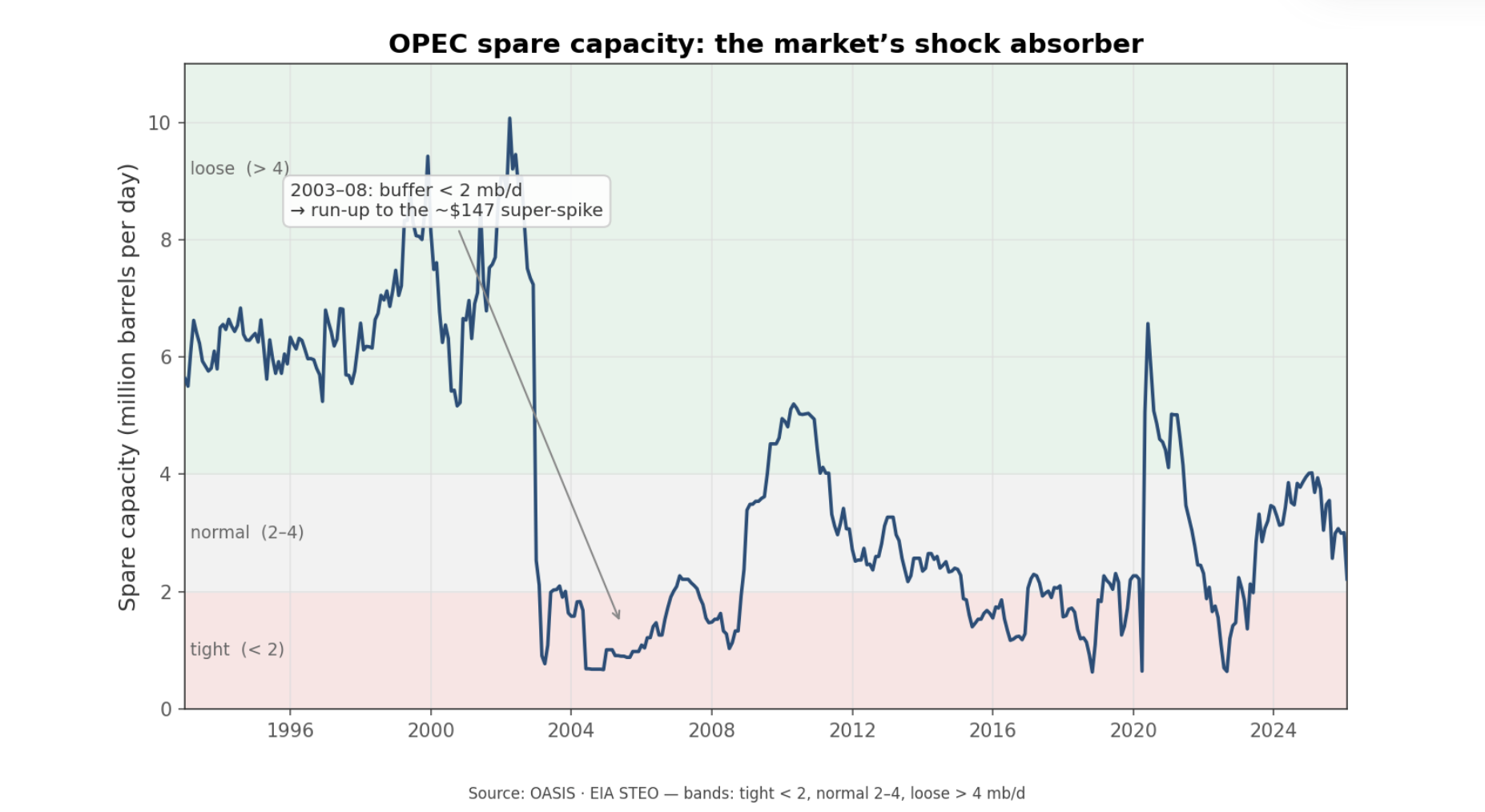
Spare capacity is the market's shock absorber. The most violent oil moves tend to happen when that buffer is already thin — the only sustained stretch below 2 mb/d, in 2003–08, ran straight into the ~$147 super-spike.
The next lever is US shale. The work here asked whether shale changed oil from a fixed supply market into a more elastic one. The evidence says yes. Rig-count changes lead production with a statistically meaningful relationship, and output per active rig nearly tripled from about 9,600 to 25,800 bbl/d between 2010 and 2024. In plain language, shale made US supply more responsive. A price shock no longer has to stay in place for years to invite new production; it can draw a domestic response within a few quarters.
Russia under sanctions was the third upstream test. Here the findings were more cautionary than dramatic. Russian output fell only modestly, from around 10.4 to 10.0 mb/d between 2021 and 2026, while the barrels Europe stopped buying were absorbed by Asia. We should read that as a flow-map story more than a supply-destruction story. It is a useful warning because the market often confuses route disruption with production loss. Sometimes they overlap, but not always.
Inventories and the dollar add the macro layer. The OECD-wide commercial stock signal matters more than the weekly US print. In a monthly decomposition of WTI returns, OECD stock changes carry a clear negative relationship with price, while US weekly stocks are only marginally useful on their own. The dollar is the strongest single measured driver in that model: when the dollar strengthens, oil usually becomes more expensive in local-currency terms for the rest of the world, which tends to weigh on demand and price. Even then, about 90% of the variance remains unexplained. That is a standing warning built into the framework: even a serious model leaves most month-to-month oil movement unexplained.
Finally, we wanted one downstream channel that links crude to the end user. The 3-2-1 crack spread does that. It measures the gross margin from turning three barrels of crude into two of gasoline and one of diesel. It averages about $10.6/bbl over 1986-2026, with a typical range of roughly $2-24, and moves cyclically with product tightness and refinery utilization. In simpler terms, it is the margin bridge between crude and the fuels households and businesses actually buy. That makes it the key translation layer from crude-market stress into pump-price pressure.
Taken together, these levers answer a question readers often ask implicitly: what should we weight heavily, and what should we discount? The framework's answer is spare capacity first, then the shale response function, then broad inventory deviations and the dollar, with the crack spread as the channel into products. The weekly US stock print matters much less than its visibility suggests.
History gives two durable rules
With the structural map and levers in place, we wanted to know whether history actually respects the framework. Across six episodes since the 1980s, two patterns dominated.
The first is that OPEC spare capacity governs amplitude. The most violent events formed on thin buffers. In 2008, WTI peaked at $144.41 and then collapsed to $35.88 by early 2009. In 2022, WTI rose to a $120.34 peak. In both cases the market was running on roughly 1-2 mb/d of spare capacity. In 2020, by contrast, the crash drove the buffer loose to around 4.2 mb/d.
The second pattern is that geopolitical spikes reverse unless barrels actually disappear. The 1990 Gulf War is the cleanest example. Iraqi and Kuwaiti output fell by about 4 mb/d combined, WTI jumped from roughly $16 to $40 in three months, and Saudi Arabia ramped from 6.4 to 8.1 mb/d to backfill the loss. Six months later WTI was 10.5% below its invasion-week level. The 2022 Russia/Ukraine shock showed a similar round trip. WTI rose 25% the week after the invasion and peaked near $120, but six months later it was only 1.1% above its invasion-week level because Russian barrels were rerouted rather than removed. Most tellingly, a model that included a broad geopolitical-risk index attributed just 0.4% of WTI's movement to it in that episode. In plain language, the war mattered, but geopolitical fear on its own explained almost none of the price move once the actual supply path was accounted for.
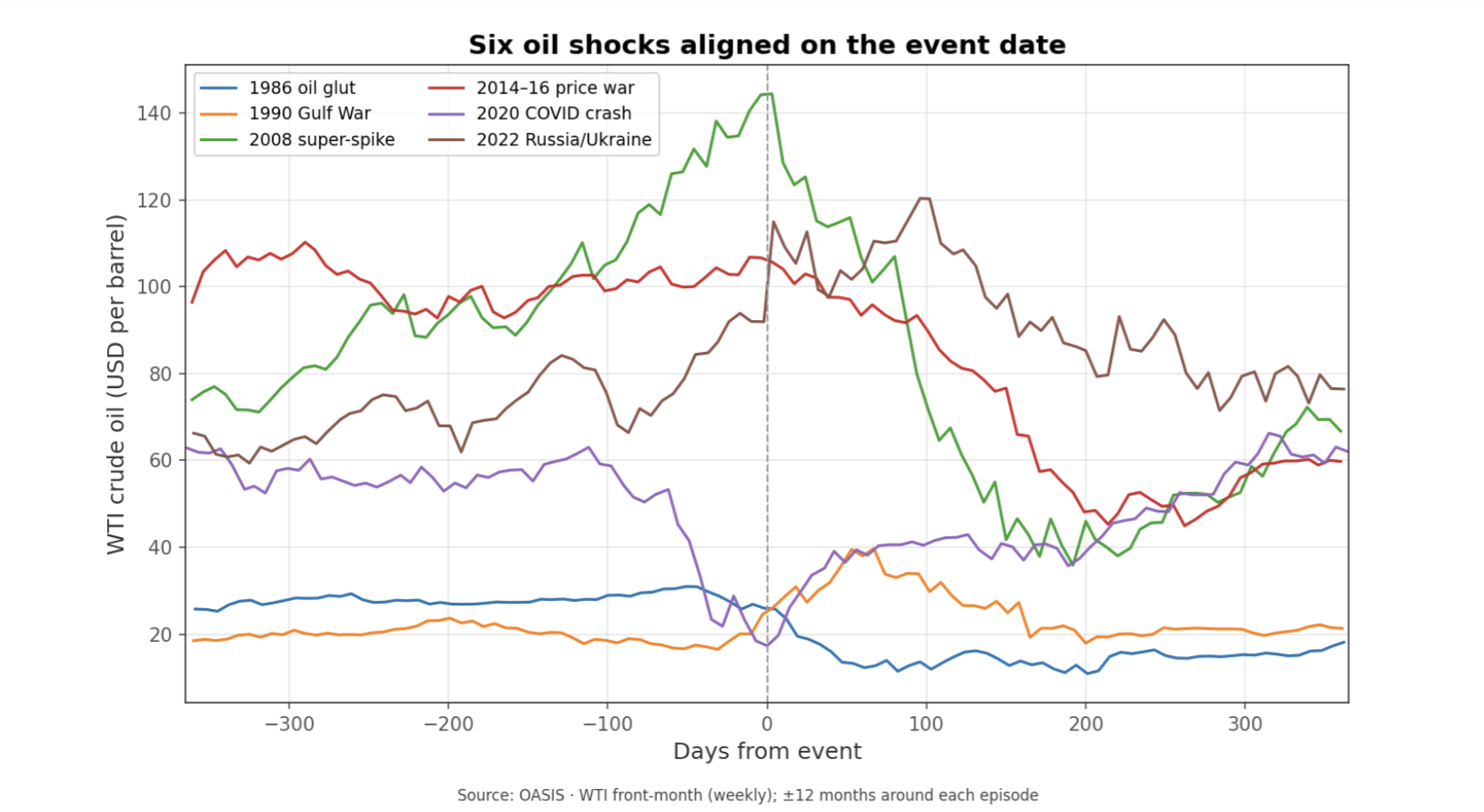
History leaves two working rules: thin spare capacity makes moves more violent, and geopolitical spikes tend to fade unless barrels are truly removed from the market.
That leaves us with a strong prior before we even turn to Hormuz. If the market is reacting to a geopolitical scare but barrels still flow, the move should tend to round-trip within months. If a violent move persists, the reason is usually not the headline in isolation but the physical supply channel the event touched. And across these episodes the unexplained share stays large — 89–98% of the weekly moves in the major post-2008 shocks — which should keep us modest about any tidy narrative.
Hormuz is the right final test
Only after building the framework did we turn to Iran and the Strait of Hormuz as the closing case study. The first point is structural importance, and on that the data are straightforward. About 20.9 mb/d moved through Hormuz in 2023, around 20.4% of global liquids output, making it the second-busiest chokepoint by raw volume and the one with the fewest practical alternatives. On importance, the narrative is right.
The second point is how the 2026 disruption is best measured. Official transit-volume series are published with a long lag, so the scale of the throughput collapse is read more reliably from price and shipping signals than from headline flow counts — and on those signals the disruption is unmistakable, with tanker traffic through the strait reported down more than 80% at the peak.
The third point is the distinction between a threatened closure and a realized one. In June 2025, the common narrative was that Iran and Hormuz were driving oil higher. WTI spiked about 23% and then round-tripped within two weeks. Brent-WTI narrowed to about +$2.46, below its +$5.19 24-month average, and Dubai showed no Asian premium. That is what a fear spike looks like when the physical system does not break.
The 2026 closure looked different. Brent-WTI widened sharply, peaking near +$18 in April and averaging roughly +$11 over the disruption window. Dubai, however, did not gain an Asian premium. Its discount to Brent blew out to -$13.7 in March and -$24.4 in April. That is a crucial finding because it inverts the naive script. The market response was not Asia bidding Gulf crude higher. It was Gulf crude being stranded behind the strait, depressing the Gulf marker relative to the globally deliverable Atlantic benchmark. In other words, the spread pattern confirms a real disruption, but by showing trapped supply rather than a classic scarcity premium in Dubai.
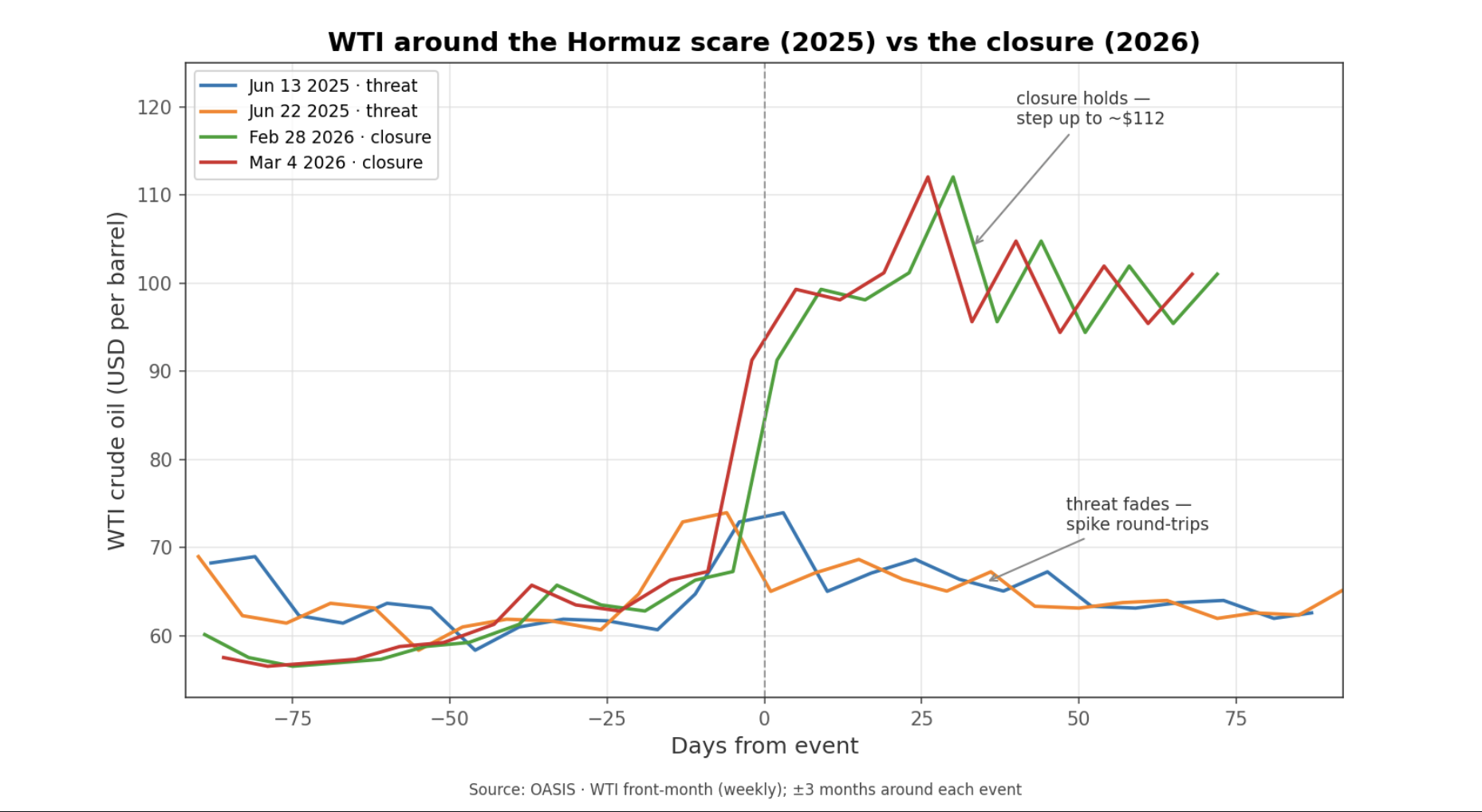
The two June 2025 scare dates (blue, orange) spike and round-trip within weeks; the two 2026 closure dates (green, red) step up to roughly $112 and hold. A threat that faded versus a closure that realized.
The supply data align with that reading. Over the recent 12 months, WTI's tightest relationships were with OPEC production at -0.95 and OPEC spare capacity at -0.94. OPEC output fell from 30.78 mb/d in February 2026 to 20.16 by May, and spare capacity collapsed from 3.01 to 0.03. The US dollar and US production explained essentially nothing over that window. Put simply, the oil market was moving with Gulf supply conditions, not with US supply or currency conditions. This is the key interpretive point: in 2026, we cannot cleanly pit "Hormuz" against "fundamentals," because the closure is itself the supply fundamental. The shock shows up as lost deliverable Gulf output and vanished usable spare capacity.
The fuller statistical picture reinforces the same lesson. In a decade-long monthly model (2015–2026), OPEC production accounts for 12.3% of WTI's movement, OECD inventories 3.7%, Russia 2.1%, and a direct "Hormuz event" term just 0.85% — with roughly 80% unexplained. That small event share should not be over-read: it swings from well under 1% to about 8% depending on how the model is built, because the Hormuz term is statistically entangled with the OPEC supply collapse the closure caused. The honest takeaway is the range, not any single figure — and the mechanism matters more than the percentage: the closure moved price through the supply channel, not as a standalone headline premium.
So the balanced answer is clear. When Hormuz is only threatened, the "Iran drives oil prices" story usually overstates the evidence. When Hormuz is actually closed, the story becomes correct, but correct as a physical Gulf-supply shock rather than as a pure geopolitical premium. And even there, we should remember that roughly 70-90% of month-to-month oil movement stays statistically unexplained. The framework helps us read the event better, but it does not turn oil into a one-variable market.
Implications
What the research suggests is a practical reading order for oil. Start with the structure: who produces, who consumes, which benchmark is moving, and whether the key regional spreads are confirming a real seaborne disruption. Then check the levers: spare capacity, broad inventory deviations, the dollar, and whether shale can respond over the next few quarters. Only after that should we decide whether a geopolitical narrative deserves to be treated as a genuine fundamental shock. For readers tracking macro transmission, the crack spread remains the useful bridge from crude to consumer prices, while the Hormuz case study leaves a clear operating rule: fade the familiar scare until spread and supply data confirm conversion, but once production and deliverability actually break, treat the move as a real supply event rather than a temporary headline premium.
What to Watch
Brent-WTI versus its roughly +$5 norm; sustained widening is the cleanest real-time sign that a Gulf or seaborne disruption is becoming global rather than staying local.
Dubai-Brent; a sharply deeper Dubai discount can signal stranded Gulf supply. It is a monthly gauge, so it confirms a shift more slowly than the daily Brent-WTI spread.
OPEC production and spare capacity together; if output falls and spare capacity compresses toward zero, the market is no longer pricing fear but an actual supply constraint.
OECD commercial stocks relative to normal, not just the weekly US crude print; the broad inventory deviation carries more signal than the headline Wednesday number.
Humility on any single-cause story; roughly 70-90% of oil's month-to-month move stays statistically unexplained, so treat any precise "X% was Hormuz" attribution with skepticism.
Look out for next week’s newsletter for further insight into the forces shaping today’s markets.
Strategy Is Building a Bitcoin Credit Market
What we found in Strategy's Q1 2026 cycle is that the headline figures matter less than the structure they sit inside. Three findings stand out: STRC alone reached $8.5 billion in nine months, management says Strategy now represents 60% of the US preferred new-issue market, and STRC is already the #2 holding in BlackRock's PFF. For readers, the key implication is that Strategy now matters less as a quirky Bitcoin proxy and more as a live test of whether Bitcoin can be continuously securitized into credit and equity products that traditional markets will absorb.
Bottom Line
What we found in Strategy's Q1 2026 cycle is that the headline figures matter less than the structure they sit inside. Three findings stand out: STRC alone reached $8.5 billion in nine months, management says Strategy now represents 60% of the US preferred new-issue market, and STRC is already the #2 holding in BlackRock's PFF. For readers, the key implication is that Strategy now matters less as a quirky Bitcoin proxy and more as a live test of whether Bitcoin can be continuously securitized into credit and equity products that traditional markets will absorb.
Thesis
We approached this research by starting with Q1 and then zooming out. On the surface, the quarter offered familiar headline figures: 818,334 BTC held as of May 3, $11.7 billion raised year-to-date, software revenue of $124.3 million, and a management-reported mNAV, or market value of the total capital structure relative to Bitcoin net asset value, of 1.27x. But as we worked through the findings, what the research kept pointing back to was something more structural. Strategy is not easiest to understand as only a software company that bought a lot of Bitcoin, nor only as a leveraged equity wrapper around BTC. By management's own framing and by the shape of the issuance data, it is trying to become the securitization layer between Bitcoin and traditional capital markets. The path through that claim is straightforward: first who Strategy is today, then what the Q1 2026 earnings cycle actually said, then how those instruments are interacting with traditional markets.
Who Strategy Is Today
One company on paper, two activities in practice
We started by asking what Strategy actually is today as a company. The findings gave a clear answer: Strategy reports a single GAAP segment, but the business now clearly operates through two activities, Bitcoin treasury operations and AI-powered enterprise analytics software.
The software side is still real. FY2025 software revenue was $477.2 million, and Q1 2026 software revenue was $124.3 million, up 11.9% year over year, with subscription services up 59%. Leadership remains centered on Michael J. Saylor as Executive Chairman, Phong Le as President and CEO, Andrew Kang as CFO, and Thomas C. Chow as EVP and General Counsel.
We also found that the capital structure is broader than many readers may assume. As of February 13, 2026, Strategy had 314.1 million Class A shares, 19.6 million Class B shares, and five preferred series outstanding: STRK, STRF, STRD, STRC, and STRE. That fifth series matters because it shows the preferred stack is not a side project. Strategy is still an operating software company, but the organizational shape now supports a much larger capital-markets experiment.
The pivot became the company
We then asked how the company moved from enterprise software vendor to Bitcoin treasury vehicle. What the research found is that the shift was not a one-off balance-sheet decision. It became formal company strategy.
The strategic shift began in August 2020 with the first Bitcoin purchase. In September 2020, the board adopted a Treasury Reserve Policy making BTC the primary treasury reserve asset. By Q1 2021, raising capital to accumulate Bitcoin had become formal corporate strategy.
From there, the funding mix evolved in three stages. From roughly 2020 through 2023, Strategy relied on ATM, or at-the-market, common issuance, senior convertibles, and a collateralized term loan. In 2024, scale stepped up with $16.33 billion of Class A ATM proceeds plus multiple convertible offerings. In 2025, the architecture changed again: five preferred series were issued alongside 2030B converts and another $13.59 billion of Class A ATM proceeds.
The shift across instruments is easier to see in the picture below.
That sequence matters because, in our findings, it reads as intent rather than improvisation. By the FY2025 10-K, management described Strategy as a Bitcoin Treasury Company that "structures and securitizes Bitcoin." The software business is still there, but it is no longer the strategic frame. It now looks more like operating ballast beneath a balance sheet designed to manufacture investable BTC-linked instruments.
A capital stack that is large, layered, and moving away from converts
Once the strategic pivot was clear, we asked what the capital structure actually looks like now. The answer from the findings is that it is already large, layered, and increasingly organized around preferred equity rather than future convertible issuance.
As of March 31, 2026, Strategy had 314.1 million Class A shares and 19.6 million Class B shares, implying a common market cap of about $62 billion.
Above that common sits a sizeable preferred layer. The five preferreds total roughly $13.5 billion notional, with STRC alone at $8.5 billion, or more than 60% of the stack. There are also six convertible series due 2028-2032 with 0.625% to 2.25% coupons totaling $8.21 billion principal, plus $40.3 million of other long-term debt. Total indebtedness was $8.25 billion, and that debt sits senior to all preferreds, meaning the preferreds rank behind in payment priority if Strategy ever had to pay creditors out.
The chart below shows the layers to scale.
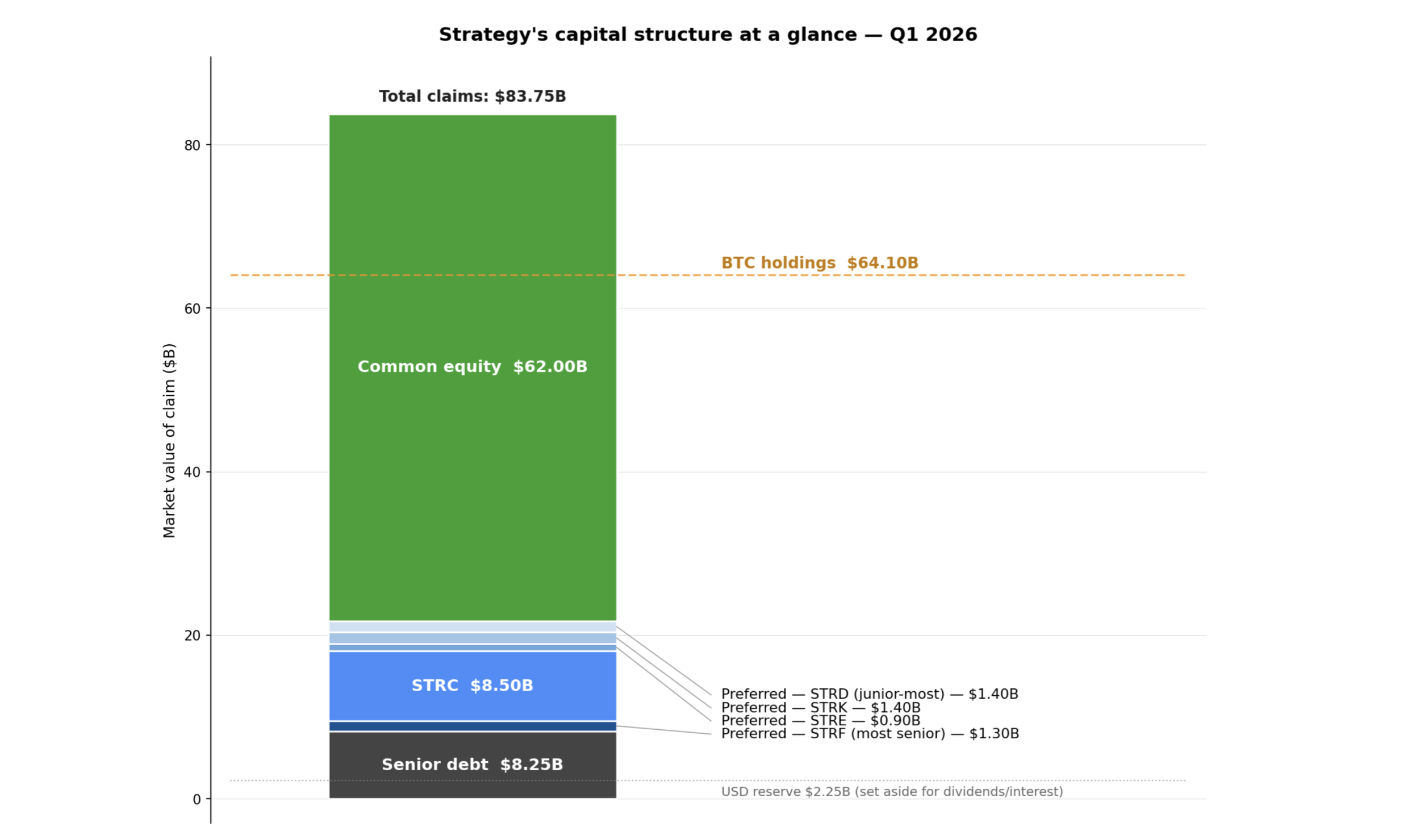
Against that sits the Bitcoin position: 818,334 BTC as of May 3, equal to 3.9% of total BTC supply and worth $64.1 billion at the cited market price, plus a dedicated USD reserve of $2.25 billion for preferred dividends and interest. We also found that management wants to equitize the convert stack over time and avoid new converts. The destination is not more debt complexity. It is common, preferred, BTC, and a cash reserve.
What the Q1 2026 Earnings Cycle Showed
Headline figures: continuity, with the machine still running
With that structure in view, we asked what Q1 itself actually showed. At the surface level, the findings looked familiar: more BTC, more capital raised, and another set of management KPIs.
Strategy reported 818,334 BTC as of May 3, worth $64.1 billion at $78,374 per BTC, with a cost basis of $61.81 billion and an average cost of $75,537.
The quarter's internally promoted performance metrics were softer than the prior comparison period. Q1 BTC Yield, the rate at which Strategy is growing Bitcoin per share, was 3.2% versus 11.0% in Q1 2025. Year-to-date 2026 BTC Yield was 9.4% versus 22.8% for FY2025. Bitcoin per share, measured against an expanded share count that includes preferreds and convertible bonds, still rose, but more slowly than a year earlier. BTC Gain was 21,329 BTC in Q1 versus 49,132 a year earlier, and BTC $ Gain was $1.45 billion versus $4.05 billion.
At the same time, the operating business remained visible. Software revenue was $124.3 million, up 11.9% year over year, with subscription revenue up 59% and gross profit at $83.4 million. Capital raised year-to-date reached $11.7 billion, split between $6.1 billion common and $5.6 billion preferred. The quarter did not change the story so much as confirm how large the machine has already become.
STRC dominated the quarter
When we asked what defined the quarter, the answer kept coming back to one instrument: STRC. The findings were decisive on that point.
Q1 2026 was decisively STRC-dominated: STRC ATM issuance raised $2.06 billion through 20.66 million shares, while Class A ATM raised $5.29 billion and STRK ATM was only $3 million. STRF and STRD ATMs were dormant.
Cumulatively, STRC reached $8.5 billion in just nine months. Management says that makes it the largest preferred stock by market cap in the world. The growth curve makes the pace clear.
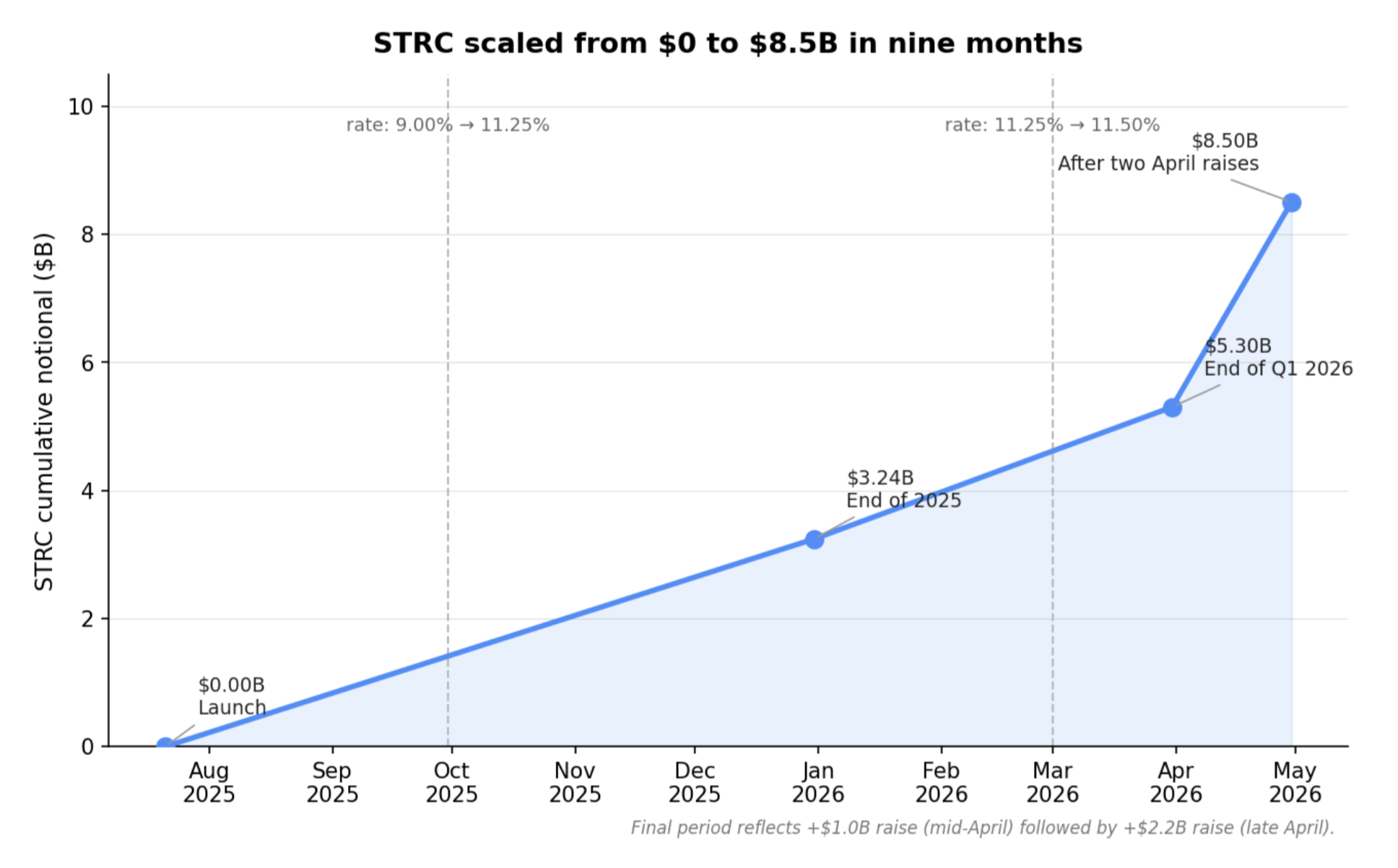
The issuance mix also shifted sharply inside the quarter. In January, ATM activity was 88% credit and 12% MSTR common. By April, it had flipped to 17% credit and 83% MSTR common as the Bitcoin drawdown reweighted issuance.
Two April weeks still stand out in the findings: one $1.0 billion raise followed by a $2.2 billion raise the next week. STRC's dividend rate was also raised from 11.25% to 11.50% effective March 1, 2026. That combination of scale, active rate-setting, and sustained issuance is what makes STRC worth attention. It is no longer a concept product. It is functioning as a primary funding channel.
The dividend-frequency proposal is product iteration, not plumbing
We also wanted to know whether the proposed shareholder vote on STRC's dividend schedule was cosmetic or meaningful. The research pointed to the second reading: this looks more like product iteration than routine plumbing.
Strategy wants to move STRC from 12 dividend payments a year to 24, starting in July 2026 if approved.
The economics do not change. The proposal changes payment frequency from monthly to semi-monthly, with the first record date on June 30, 2026 and the first payment date on July 15, 2026. Management's stated reason is direct: improve attractiveness, enhance liquidity, and support better price stability.
That matters because, in the findings, STRC is being managed as an instrument whose market behavior can be tuned. The company is not simply issuing preferred stock and accepting whatever secondary-market profile follows. It is actively adjusting the user experience of the security in order to deepen demand and stabilize the channel. In that sense, the dividend-frequency proposal belongs in the same family as the coupon adjustments and price-band management. It is another signal that Strategy is iterating a market product, not merely maintaining a funding line.
Forward guidance reads like a balance-sheet blueprint
We then asked what management's forward guidance was really describing. The answer from the research is that it reads less like ordinary guidance and more like a blueprint for how the balance sheet is meant to scale.
Saylor's headline statement was the clearest version: Strategy expects to pass 1 million Bitcoin on the balance sheet within the next 36 months while funding all obligations with Bitcoin.
That sits inside a broader set of commitments. Management laid out a goal to double Bitcoin Per Share in seven years under a scenario assuming 16% Digital Credit issuance, a 9% dividend rate, and 1.75x mNAV. It also outlined six capital-markets principles: increase Bitcoin per share; grow STRC demand; reduce convertible debt proactively; size the USD reserve to credit demand and risk; adjust issuance scale to market conditions; and remain willing to sell BTC when advantageous.
The operating rule set for STRC was equally specific. If monthly average traded price falls below $95, management would recommend at least a 0.50 percentage-point rate increase; between $95 and $99, at least 0.25 percentage points; above $101, a rate decrease and/or follow-on offering. The message from the findings is straightforward: this is not passive treasury management. It is active balance-sheet engineering.
The macro framing was capital-markets disruption, not a Fed call
We also asked how management chose to frame the quarter. The findings here were notable because the central story was not the usual monetary-policy discussion. It was capital-markets disruption.
Strategy's own language was that it transforms "Digital Capital into Digital Credit and Equity," positioning itself as the securitization layer between a $1.6 trillion Bitcoin market cap and traditional preferred or fixed-income buyers.
Three threads carried that framing. First, Bitcoin was presented as programmable capital. Second, STRC was presented as a credit-index inhabitant, with Saylor stating that "Stretch is the #2 holding in BlackRock's PFF," the $14 billion preferred ETF. Third, management argued Bitcoin's risk-and-return profile can be split into a high-yield, lower-volatility credit product, STRC, and a higher-volatility equity product, MSTR common.
Phong Le also made the near-term demand point explicit: demand is more constrained by awareness and market development than by Fed moves. The quarter was therefore less a monetary-policy commentary than a product-distribution commentary.
In the Q&A, management treats the stack as a dynamic machine
Finally, we looked at what the analysts were actually asking and how management answered. That part of the research reinforced the same thread: management appears to treat the stack as a dynamic machine rather than a set of separate financing buckets.
Eight named analysts focused on five broad themes: proactive capital-stack management, the effect of lower rates, decentralized finance, or DeFi, products built on STRC, decentralization concerns as institutions accumulate BTC, and what lower BTC volatility would do to the model.
Across those answers, management's thread was consistent. It is willing to sell BTC for tax or optimization reasons, retire all convertible bonds, which can convert into shares under set conditions, via STRC, equity, or cash, and lean further into the use of leverage if BTC volatility falls. On the DeFi question, management said yield coins and leveraged yield products are already being built on STRC. On the relative-risk debate, Saylor said the market "does not yet agree."
That matters because it reveals the mindset behind the structure. Management does not appear to view the preferreds, converts, common ATM, and BTC position as separate financing buckets. It views them as coordinated levers. The quarter's educational value is not just in the numbers reported, but in how openly the company described the operating logic of the machine.
Where These Instruments Sit in Traditional Markets
Demand is strongest in STRC, but the spreads still say credit risk
Once the quarter's internal logic was clear, we asked how these instruments compare with traditional markets. The first answer was that demand is strongest in STRC, but the pricing still says credit risk rather than something Treasury-like.
The clearest demand signal is STRC: year-to-date 2026, all $5.6 billion of preferred ATM issuance came through that one series. Retail ownership is roughly 80%, and daily liquidity rose from $54-120 million in January to $360 million in April. Management says STRC turnover is 10 times that of Wells Fargo preferred.
The cross-section also matters. STRK carries an 8.00% fixed coupon, has returned -7.79%, and saw a -41.98% max drawdown. STRF carries a 10.00% fixed coupon, returned +23.18%, and had a -21.76% drawdown. STRD carries a 10.00% fixed coupon, returned +2.92%, and had a -29.09% drawdown. STRC, now at an 11.50% variable rate, returned +22.52% with only a -4.02% max drawdown.
But the yield and spread comparisons keep the framing honest. Versus PFF's typical roughly 6% distribution yield, MSTR preferreds run about 4 to 7 percentage points wider. Versus today's 2.79 percentage-point spread over Treasuries for high-yield corporate credit, they price 2 to 4 times wider than high-yield corporate credit.
STRF looks Treasury-adjacent but is not a Treasury substitute
We wanted to see whether any of the preferreds behaves like a Treasury substitute. STRF was the closest candidate, and the answer turned out to be subtler than we expected.
Within the preferred stack, it is the most senior preferred, cumulative, meaning missed dividends accrue and must be paid before common dividends resume, fixed at a 10.00% coupon, has no conversion feature, and no ordinary call. It also trades closest to par, at $100.55 latest and $105.58 on November 10, and delivered the best realized total return of the four at +23.18%.
The limits are just as important. STRF's peak-to-trough drawdown was -21.76% over 37 weeks, which is not compatible with literal "no-risk" language. Its spread versus the US 10-year at the November 15 anchor was +5.33 percentage points, firmly in high-yield-credit territory by spread. And structurally, it is subordinated to $8.25 billion of senior debt plus all subsidiary liabilities.
The right comparison from the findings is therefore not Treasury substitute. It is "treasury-spread fixed-coupon perpetual." That sounds like a narrower distinction than it is. STRF may be the most bond-like product in the stack, but the evidence still places it much closer to long-duration high-yield risk than to Treasury cash-equivalent behavior.
Strategy is already large enough to matter in the markets it touches
We then asked whether Strategy is actually large enough to influence the markets it touches, or whether the disruption framing is still mostly rhetorical. The research came back with a fairly clear answer: by management's own market-share figures and by the market-microstructure signals, it is already large enough to matter.
By management's figures, Strategy's share of US capital-markets issuance rose from 8% in 2025 to 10% in 2026 year-to-date.
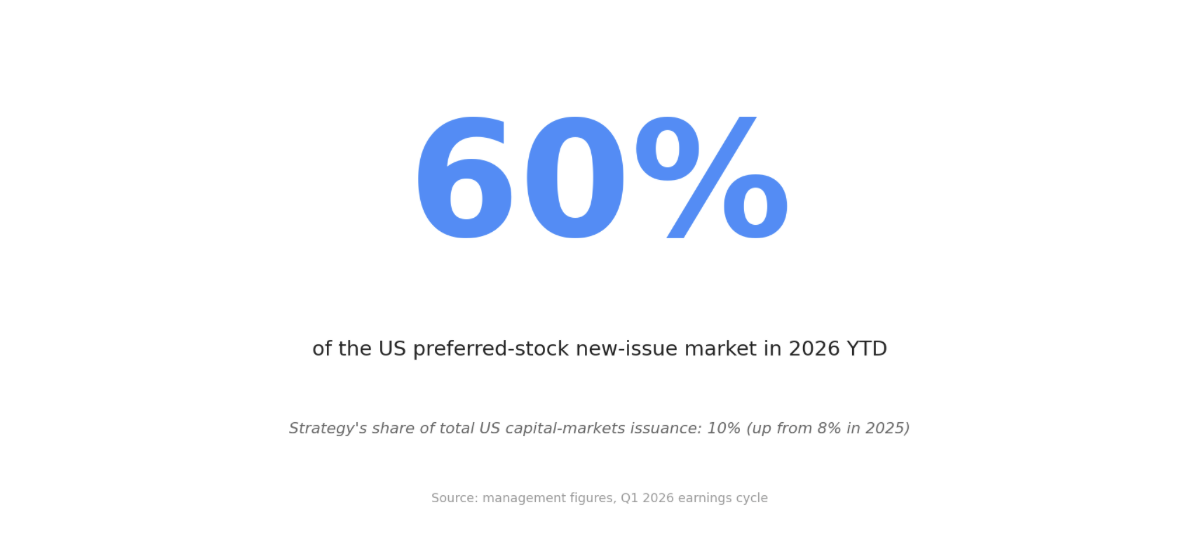
Inside that, the preferred-equity figure is the eye-catching one: 60% of the US preferred new-issue market, alongside 6% of common-equity issuance. Since the Bitcoin pivot, cumulative issuance is estimated at $81.75 billion. The headline figure is the one worth keeping in mind.
The market-microstructure evidence lines up with the issuance share. STRC daily liquidity rose from $54-120 million in January to $360 million in April, and management says turnover is 10 times that of Wells Fargo preferred. STRC is also said to be the #2 holding in BlackRock's PFF.
The direct-pricing signal remains the cleanest expression of that influence. STRC has held its $99-101 trading band 100% of the time since the ATM was anchored there, and management raised the coupon from 9.00% to 11.25% to 11.50% instead of letting the price slip during BTC drawdowns. The broader preferred-market impact is not fully verified, but the instrument-level influence is already material.
Implications
The research points to a simple but important conclusion: Strategy deserves attention now less because it owns a lot of Bitcoin and more because it is testing whether Bitcoin can support an enduring securitization layer across common equity, preferred equity, and eventually a simplified post-convert capital stack. For readers tracking capital markets, the relevant signal is not just BTC sensitivity. It is product acceptance. STRC's scale, liquidity growth, ETF penetration, and price-band mechanics suggest that at least one instrument has already crossed from concept into functioning market object. At the same time, the spreads, drawdowns, subordination, and the company's tax framing for preferred dividends suggest caution in how the products are interpreted. This is a live capital-markets innovation, not a cash-equivalent revolution. The interesting question the research leaves us with is not whether the products exist. It is whether demand remains durable enough for the issuance machine to keep compounding without a major break in the stack's risk pricing.
What to Watch
What the findings suggest is worth watching next is straightforward:
Whether STRC continues to hold the $99-101 trading band after the proposed move to semi-monthly dividends; that is the cleanest test of whether the product-design tweaks are still improving liquidity and price stability.
Whether preferred issuance remains concentrated in STRC or broadens again to STRF, STRD, or STRK; Q1's $5.6 billion preferred ATM being entirely STRC is a strong but narrow demand signal.
Whether management actually reduces the $8.21 billion convertible stack over coming quarters; the stated destination is common plus preferred plus USD reserve, so convert retirement is the key execution test.
Whether STRC retains meaningful benchmark-style demand, especially its stated position as the #2 holding in BlackRock's PFF; sustained ETF and retail absorption matters more than one quarter of issuance volume.
Whether BTC accumulation keeps tracking the stated 1 million BTC in 36 months goal without forcing a visible deterioration in pricing across the preferred stack, particularly given STRF's high-yield-like spread profile and the broader subordination beneath $8.25 billion of senior debt.
Look out for next week’s newsletter for further insight into the forces shaping today’s markets.